Risk Register
I want to plan a project...
by managing risks to its success
This tool identifies possible project risks and helps you avoid possible problems down the road.
What is it?
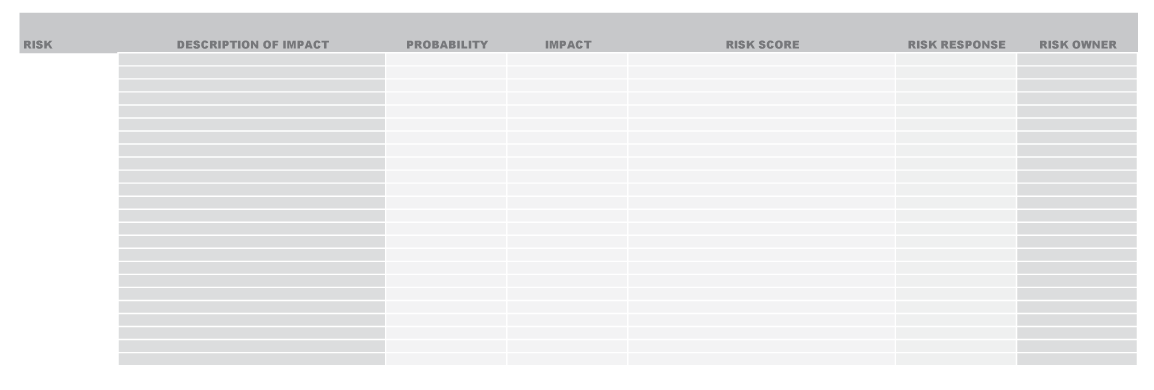
It’s a process that involves identifying risk categories that could affect your work, ranking these in order and applying a ‘risk score’ to each. If the score is too high for one of your risks, then a ‘risk reduction strategy’ needs to be applied.
Your output will be a table indicating the ‘risk categories’ in the left column, and outlining the risk itself, its status, score, and your response (who and when) in the top row headings. Allocating a person to manage each of the risks in a time-bound and accountable way is extremely important.
How do I use it?
In its project to reduce the number of unhoused youth in the city, Havenford Cares identified 1) Security issues in the neighborhood, especially after dark, 2) cement shortages, and 3) unmotivated volunteers as potential risks to their project.
Risk to your project could involve political, legal, organizational, human, financial, technical or environmental considerations.
Management: The goal of risk management is not to eliminate risk altogether. It’s about being able respond if risk exceeds project tolerance levels. Risks with a high score will need to be managed and that risk reduced.
You may decide to avoid a risk by not doing something or doing something differently. This could involve moving to a different location because of insecurity, or in the case of Havenford Cares, deciding close the homeless youth drop-in center at 5 PM.
You could transfer a risk by shifting it to another project area or another party. The most common example of this is transferring the risk of vehicle damage to an insurance provider. In the case of Havenford Cares, this could involve buy insurance.
You could reduce or mitigate a risk so that it is acceptable. If Havenford Cares was concerned about security issues in the neighborhood, especially after dark, the team may consider reduce the probability or impact of insecurity around the drop-in center by hiring a security guard. Or you may decide to accept some element of risk because you have assessed that it is reasonable.
When do I use it?
You will need to continually revisit and update your Risk Register. As your project evolves, some risks will be resolved or diminish in importance. Others may surface and should be added to the register. Working in this way enables you to stay one step ahead of risks, addressing them BEFORE they become serious issues.
Who is involved?
Tips:
Additional Resources
content originally Developed by:



Brought to you by:
In collaboration with:



Users are free to copy/redistribute and adapt/transform
for non-commercial purposes.
© 2025 All rights reserved.
 .
.